

In ‘The Salt Fix,’ Dr. James DiNicolantonio says,
“You could live the rest of your life without eating another granule of sugar, but you can’t stay alive very long without SALT.”
What is he talking about? Like so many commonly held misconceptions, many people believe that salt – especially too much salt – can increase your blood pressure and is thus ‘bad for your health.’ Doctors have been telling patients to avoid eating too much salt since the early 1900’s, but there is very little scientific evidence to support those warnings, according to Dr. DiNicolantonio. He says salt (sodium and its electrolyte brethren) is essential to good health, and that we cannot live without it. (The Salt Fix, June 2017)
There were several studies that showed a variety of outcomes with no clear winner – is salt good for you or not? – for more than 80 years. Then a researcher named Lewis Dahl from one of the ‘National Labs’ in the 1970’s claimed to have ‘unequivocal evidence’ that salt causes hypertension. It turns out that he fed lab rats more than 500 grams of sodium per day to induce high blood pressure. Americans consume less than four (4g) grams per day. (Scientific American, July 2011) Nevertheless, in 1977 the U.S. Senate’s Select Committee on Nutrition released a report recommending Americans cut their salt intake by 50-85 percent, based largely on Dahl’s research. Senator George McGovern’s merry band of Senatorial health experts included notables such as Ted Kennedy, Herman Talmadge, Walter Mondale, Bob Dole, and Hubert Humphrey. This group of health experts probably did more damage to Americans’ health than the cigarette manufacturers by promoting a diet low in salt, fat and protein (meat), and high in carbohydrates and sugar. Just look at obesity rates in the U.S. since their report was issued: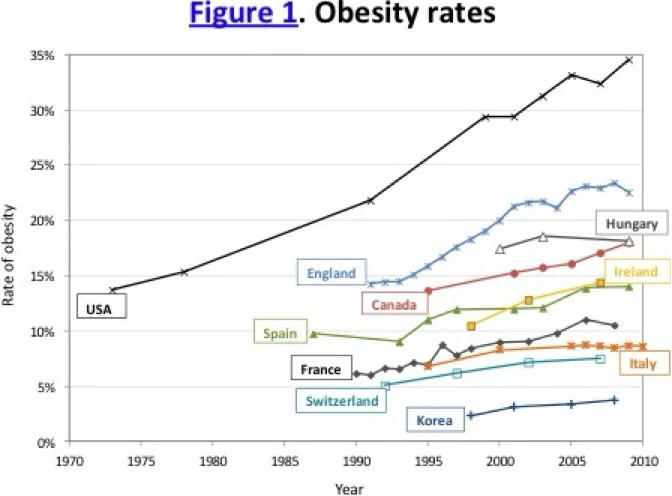
It turns out there are several studies showing that consuming too little salt can be very harmful to your health. And if you do consume too much salt, your body quickly gets rid of it through sweat and urine. According to Dr. DiNicolantonio, salt gives you energy; improves hydration; reduces muscle cramps; improves your workouts; and stops sugar cravings.
But what about those studies that show salt is bad for you? As we have seen with many ‘lab rat studies,’ if you smother a lab rat with 200 times the normal amount of whatever substance the researcher is trying to prove is bad for you, the outcomes are usually not good. Many of the participants in the studies that showed salt sometimes raises blood pressure had significant insulin resistance. Other studies used highly processed foods full of chemicals and synthetic salts to show bad outcomes from high salt diets.
As the following chart shows, consuming a healthy amount of natural salt regularly can add years of healthy living to your life. Live the Salt Life!
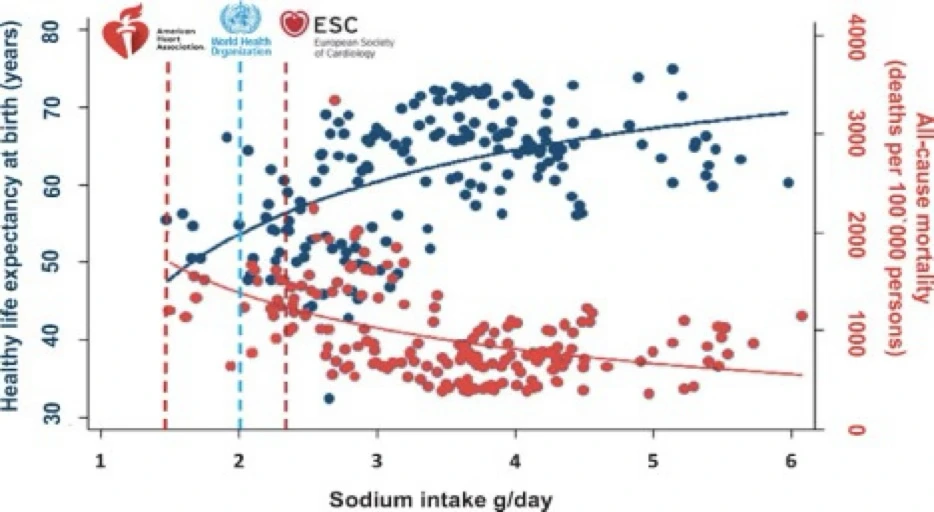
European Society of Cardiology. Volume 42, Issue 21. June 2021. Oxford University Press. All Rights Reserved
As always, this article is based on our personal beliefs and not intended to treat or diagnose any disease, condition, or illness.