
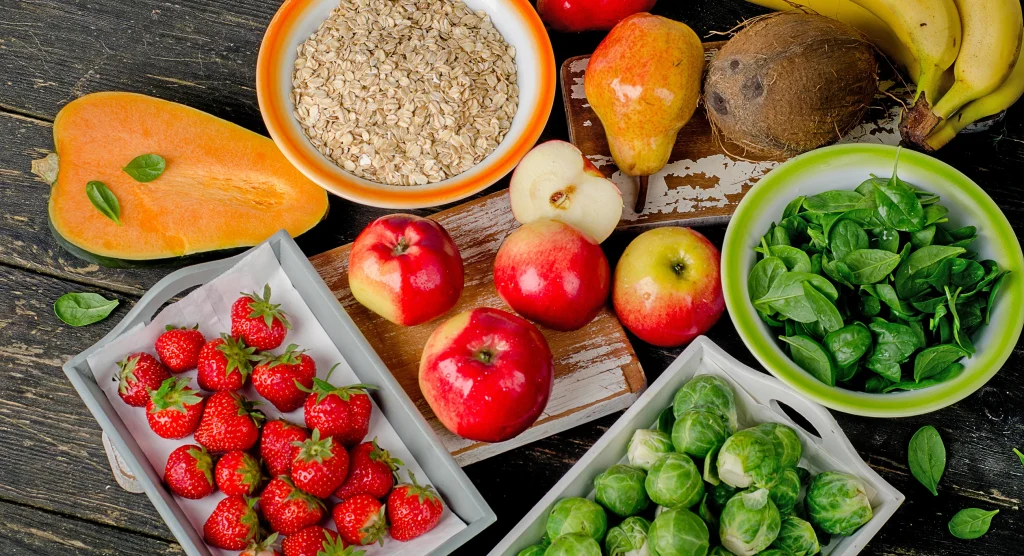
Soluble fiber is the part of fruits and vegetables that your body can absorb. It is water soluble.
Insoluble fiber is the part of fruits and vegetables (and grains) that your body cannot absorb. It is not water soluble. It is what gives fruits and vegetables their structure, and it cannot be broken down or digested. We are told insoluble fiber adds weight and bulk to our intestines and helps to ‘move things along’ through our digestive system. But if you are suffering from constipation, adding more indigestible materials to an already clogged system can actually make the situation worse. (Journal of Gastroenterology 2007). There is also this popularly held idea that consuming a bunch of insoluble fiber ‘scrubs your intestinal walls clean.’ But did you know that the interior lining of your intestines (the epithelium) completely replaces itself twice a week? (Frontiers in Cell & Developmental Biology 2020).
According to Harvard Medical School, soluble fiber can lower cholesterol, but is it lowering the ‘bad cholesterol’ or the ‘good cholesterol?’
Soluble fiber can slow down digestion and thus lower blood sugar spikes. But instead of causing a blood sugar spike by eating a banana to get some good fiber, maybe we should just avoid the foods that cause the blood sugar spike in the first place.
Soluble fiber can help you lose weight. Some studies have shown that soluble fiber swells and slows down digestion, so we may feel fuller faster, and eat less.
According to Harvard Medical School, soluble fiber can lower cholesterol, but is it lowering the ‘bad cholesterol’ or the ‘good cholesterol?’
Soluble fiber can slow down digestion and thus lower blood sugar spikes. But instead of causing a blood sugar spike by eating a banana to get some good fiber, maybe we should just avoid the foods that cause the blood sugar spike in the first place.
Soluble fiber can help you lose weight. Some studies have shown that soluble fiber swells and slows down digestion, so we may feel fuller faster, and eat less.
But if we need to lose weight, maybe we should just refrain from eating those foods that are high in fiber – but are also very high in sugar and carbohydrates.
According to the US Department of Agriculture, Americans should consume 25-30 grams of fiber every day. But is that recommendation for soluble fiber or insoluble fiber? Should we get that fiber from fruits and vegetables, or beans and bread? They don’t say. If you want to do fruit, you could eat eight apples per day, or 10 bananas. Prefer veggies or bread? You would have to eat six cups of Brussels sprouts, five cups of broccoli, or 10 cups of raw cauliflower. Hmmm. Or how about 15 slices of bread? Talk about a blood sugar spike! Surely whatever benefits we would get from 25-30 grams of fiber every day would be made worse by consuming all of those carbohydrates, and the subsequent sugar spikes and weight gains.
Should you still try to consume 25-30 grams of fiber from carbohydrates? No! According to the American Diabetes Association’s 2019 Consensus Report: Reducing carbohydrate intake for individuals with diabetes has demonstrated the most evidence for improving glycemia [blood sugar control]. So maybe all that fiber is not so good after all.