Posted on

Dr. Gerson’s Green Juice

Dr. Max Gerson emigrated from Germany in the 1930’s and practiced medicine in New York City for more than 20 years. He first began treating tuberculosis patients in Germany in the 1920’s with Dr. Ferdinand Sauerbruch, a thoracic surgeon, and nutritionist Walter Hermannsdorfer, at Munich University Hospital. They conducted a clinical trial on patients with skin tuberculosis, which was considered very difficult to treat at the time. According to the articles published in German medical journals, 446 patients out of 450 achieved complete recovery – that’s 99 percent! German Nobel Laureate Albert Schweitzer praised the Gerson Diet for curing his wife’s lung tuberculosis. Schweitzer and Gerson became lifelong friends, and he credited the Gerson Diet for curing his own Type II Diabetes. (Gerson Institute 2023)

Dr. Gerson pioneered the radical idea that diet could affect health by emulating Hippocrates’ own theorem, ‘Let food be thy medicine, and medicine be thy food.’ Like many great doctors and scientists before him, Dr. Gerson first tried out his diet hypothesis on himself to treat his own migraine headaches. Around the same time in Germany in the 1920’s, the famous Nobel Laureate biochemist, Otto Warburg, was figuring out that cancer cells feasted on sugar. (Ravenous, Sam Apple, 2021) The Gerson Diet would go on to be used to treat many diseases including heart disease, kidney failure, and cancer. In New York, Dr. Gerson successfully treated hundreds of cancer patients who were told no conventional medicine could help them. The Gerson Diet is based on Dr. Gerson’s philosophy that the human body’s immune system can heal itself if given the proper nutrition. Some patients’ illnesses were so far along that changing to a healthier diet would not cure them. But many patients did achieve full remission of diabetes, tuberculosis and cancer.

Journey Juice’s Version of the Gerson Green Drink

Journey Juice’s version of the Gerson Green Drink is three full pounds of fresh, raw veggies with some lemon juice and Granny Smith apples. The vegetables include red leaf lettuce, green leaf lettuce, swiss chard, bell peppers, and red cabbage. These cruciferous vegetables and lettuces contain glucosinolates, which break down into biologically active sulfur compounds called isothiocyanates (e.g., sulforaphane, AITC, indole-3-carbinol). These substances have shown in lab studies to inhibit cancer cell growth in breast, colon, prostate, and cervical cancer. (Palo Verde Cancer Specialists 2024) This juice contains a lot of vitamin C and other potent antioxidants and is anti-inflammatory. Like all of Journey Juices cold-pressed juices, the cold-pressing of the fruits and vegetables make their healthy compounds more bioavailable than cooked or whole raw veggies. The juicing also removes the insoluble fiber which makes your body absorb the antioxidants and phytochemicals faster and with less stress on your digestive system. A study in PubMed showed better absorption of beta carotene from cabbage juice than from whole cabbage. (NIH 2019)

One of Journey Juice’s favorite friends and influencer is Courtney Campbell of Green Drink Diaries fame (anticancermom.com) She and Amy taught school together in Atlanta. Courtney takes green juice drinking to a whole other level. She successfully battled cancer holistically in her 20’s, because she wanted to have healthy babies. She was diagnosed in 2008 at the age of 26. More than 15 years later (and six healthy children!), she is cancer free.

There are many ways to prevent and cure diseases and stay healthy. Eating and drinking clean foods without unpronounceable poisonous ingredients is a great place to start. And incorporating a Journey Juice or two into your daily routine is one of the easiest ways to get many of the healthy ingredients our bodies crave. As Amy always says, ‘Journey Juice will make your cells dance!’

As always, these articles are our personal opinion and should never be interpreted as medical advice.


Posted on

Let’s Talk About Salt

In ‘The Salt Fix,’ Dr. James DiNicolantonio says,

“You could live the rest of your life without eating another granule of sugar, but you can’t stay alive very long without SALT.”

What is he talking about? Like so many commonly held misconceptions, many people believe that salt – especially too much salt – can increase your blood pressure and is thus ‘bad for your health.’ Doctors have been telling patients to avoid eating too much salt since the early 1900’s, but there is very little scientific evidence to support those warnings, according to Dr. DiNicolantonio. He says salt (sodium and its electrolyte brethren) is essential to good health, and that we cannot live without it. (The Salt Fix, June 2017)

There were several studies that showed a variety of outcomes with no clear winner – is salt good for you or not? – for more than 80 years. Then a researcher named Lewis Dahl from one of the ‘National Labs’ in the 1970’s claimed to have ‘unequivocal evidence’ that salt causes hypertension. It turns out that he fed lab rats more than 500 grams of sodium per day to induce high blood pressure. Americans consume less than four (4g) grams per day. (Scientific American, July 2011) Nevertheless, in 1977 the U.S. Senate’s Select Committee on Nutrition released a report recommending Americans cut their salt intake by 50-85 percent, based largely on Dahl’s research. Senator George McGovern’s merry band of Senatorial health experts included notables such as Ted Kennedy, Herman Talmadge, Walter Mondale, Bob Dole, and Hubert Humphrey. This group of health experts probably did more damage to Americans’ health than the cigarette manufacturers by promoting a diet low in salt, fat and protein (meat), and high in carbohydrates and sugar. Just look at obesity rates in the U.S. since their report was issued:

It turns out there are several studies showing that consuming too little salt can be very harmful to your health. And if you do consume too much salt, your body quickly gets rid of it through sweat and urine. According to Dr. DiNicolantonio, salt gives you energy; improves hydration; reduces muscle cramps; improves your workouts; and stops sugar cravings.

But what about those studies that show salt is bad for you? As we have seen with many ‘lab rat studies,’ if you smother a lab rat with 200 times the normal amount of whatever substance the researcher is trying to prove is bad for you, the outcomes are usually not good. Many of the participants in the studies that showed salt sometimes raises blood pressure had significant insulin resistance. Other studies used highly processed foods full of chemicals and synthetic salts to show bad outcomes from high salt diets.

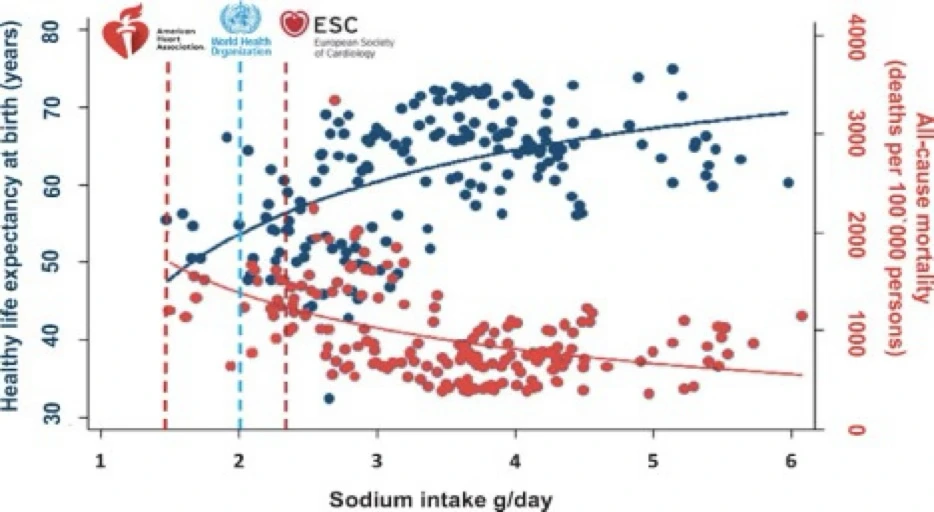
As the following chart shows, consuming a healthy amount of natural salt regularly can add years of healthy living to your life. Live the Salt Life!

European Society of Cardiology. Volume 42, Issue 21. June 2021. Oxford University Press. All Rights Reserved

As always, this article is based on our personal beliefs and not intended to treat or diagnose any disease, condition, or illness.

Posted on

Piñas & Peppers

Did you know that pineapple juice is a super food? It is not only delicious and sweet, it is actually considered to be ‘low-glycemic.’ It’s not inherently ‘low glycemic,’ but as far as fruit juices are concerned, it is one of the lowest.

When combined with green leafy vegetables and fresh organic jalapeños, pineapple juice packs a powerful punch. Journey Juice’s ‘Pineapple Greens’ contains just that: Fresh, cold-pressed pineapple juice with lots of green leafy vegetables and some fresh organic jalapeños.

Nutrient Density and Digestive Health

Pineapples are a rich source of vitamin C, manganese, and bromelain, a digestive enzyme that aids in breaking down proteins and reducing inflammation. According to a 2018 study in Food Science & Nutrition, bromelain supports digestion and may alleviate symptoms of inflammatory bowel conditions (Fitzhugh & Yeh, 2018). Green leafy vegetables like kale, spinach, or Swiss chard are packed with vitamins A, C, and K, as well as folate and fiber. These nutrients support immune function, bone health, and gut regularity. The fiber in whole greens is partially retained in cold-pressed juice, promoting a healthy digestive system compared to traditional juicing methods (Slavin & Lloyd, 2012).

Anti-Inflammatory and Antioxidant Properties

Jalapeños add a spicy kick and a dose of capsaicin, a compound known for its anti-inflammatory and pain-relieving properties. A 2016 review in Molecules found that capsaicin may reduce inflammation and oxidative stress, potentially lowering the risk of chronic diseases (Clark & Lee, 2016). Pineapples and leafy greens are also rich in antioxidants, such as vitamin C and flavonoids, which combat free radicals and reduce cellular damage. A 2020 study in Nutrients emphasized that diets high in antioxidant-rich fruits and vegetables, like those in this juice blend, are linked to lower risks of cardiovascular disease and cancer (Aune et al., 2020).

Metabolic and Immune Support

The combination of these ingredients supports metabolic health and immunity. Pineapples provide natural sugars for quick energy, while their low glycemic index helps maintain stable blood sugar levels. Jalapeños may boost metabolism due to capsaicin’s thermogenic effect, which increases calorie burning, as noted in a 2017 study in Bioscience Reports (Zheng et al., 2017). Leafy greens contribute chlorophyll and magnesium, which support detoxification and immune function. Cold-pressing ensures these nutrients remain intact, delivering a concentrated dose of vitamins and minerals that enhance the body’s ability to fight infections and maintain energy levels.

Weight Management and Hydration

This juice blend is low in calories yet nutrient-dense, making it an excellent choice for weight management. The high water content in pineapples and greens promotes hydration, essential for overall health and appetite regulation. The spicy kick from jalapeños may also suppress appetite, aiding in portion control. Additionally, the vibrant flavor profile makes this juice an appealing alternative to sugary beverages, supporting healthier dietary choices.

Cold-pressed juice with pineapples, jalapeños, and green leafy vegetables is a delicious and nutritious way to boost health. Its benefits include improved digestion, reduced inflammation, enhanced immunity, and support for weight management. By preserving vital nutrients, cold-pressing maximizes the health potential of this vibrant blend, making it a valuable addition to a balanced diet. So the next time you are in Journey Juice, give Pineapple Greens a try. As Amy always says, ‘It will make your cells dance!’

As always, these articles are our personal opinion and should never be interpreted as medical advice.
Amy & Barth, July 16, 2025