
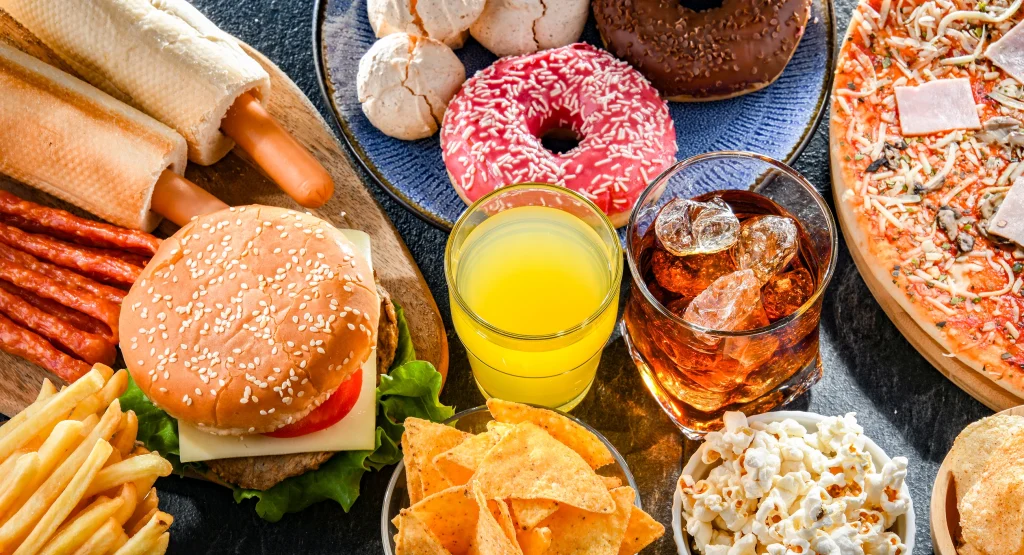
Take a quick look at the ingredients in Heinz Ketchup made for American consumption. Then take a look at the ingredients for the ketchup Heinz makes for European consumption. Why are they different? It turns out that many major American food manufacturers – Big Food – make a totally different product for European consumers than their American customers. Why? Because they can. It’s much cheaper and way more profitable to sell Americans highly processed food with many artificial ingredients that are illegal to sell in Europe. Ketchup is the first example because it’s so simple. It’s tomatoes, sugar, salt & pepper and maybe some basil and oregano. That’s it.
Heinz adds high fructose corn syrup, then another version of corn syrup, then ‘natural flavors.’ Pro Tip: Anytime you see ‘natural flavors’ on an American-made food ingredient list— Mangiatore Attento!! (Eater Beware!) The USDA does not regulate that phrase so ‘Natural Flavors’ can be anything. Raspberry flavoring, anyone?
It turns out that the USDA allows a whole host of artificial ingredients that are outlawed in Europe. So Big Food, like Kelloggs, Post and McDonald’s, fill their highly processed products with artificial ingredients that lower their costs and (maybe) lower your life expectancy. The Europeans do not allow those companies to add artificial ingredients; therefore, they don’t put all that poison in the products they sell in Europe. Those companies, also, do not make as much money in Europe as they do here in the United States.
Have you ever had a Coke from Mexico? It tastes more like the Coke we drank in our childhood than the Coke made in the US today. Why? Because the Mexican Coke is sweetened with real sugar, and the American Coke is sweetened with high fructose corn syrup which is cheaper to make.
Here’s a fun Third Grade Science Class experiment you can do at home: Put one sugar cube in a tub of margarine (vegetable oil) and one sugar cube in a stick of real butter. Then sprinkle a little sugar on the outside of both the margarine and the real butter. Then put both close to an ant hill on the playground. Ants love sugar, and they will spend hours fighting through all sorts of substances and barriers to get to a sugar cube. They will eat through the stick of butter to get to the sugar cube, but they WILL NOT eat through the margarine. Why not? Instinctively, they know the vegetable oil will kill them.
Unfortunately the American government – USDA (agriculture), FDA (food & drugs) – approaches its citizens’ health and safety with a ‘wait and see’ attitude. Whereas, the European governments exercise the ‘Precautionary Principle’ (Basic Definition: Don’t feed your people suspected poison just because you don’t have scientific proof it is bad for their health). When it comes to health and safety regulations for American-made food, we are all just a bunch of lab rats. If something makes enough of us sick, they will outlaw it. But it takes decades for this grand experiment to reveal definitive results so the collateral damage is long since done. (e.g., US average life expectancy vs European: Men 75 vs 80; Women 80 vs 84. CDC 2022)
Consumer advocate and food safety expert Vani Hari (AKA The Food Babe, www.foodbabe.com) has been researching American made food ingredients for more than a decade. She has successfully led several lobbying campaigns to force many Big Food companies to stop using dangerous chemicals and artificial ingredients in their products. Her Food Babe Army collected more than 380,000 signatures on a petition presented to Kraft Foods demanding they remove harmful petroleum-based yellow dyes from their very popular Mac & Cheese. Fortunately for Americans, there is a wealth of information out there about healthy food as well as many consumer advocates like Vani who are doing the hard work of exposing the unhealthy food. We have to be our own advocates and educate ourselves about what is healthy and what is
not. Remember what Amy always says: “If you cannot pronounce an ingredient, it’s probably not good for you.”